|
|

|
|
08:08:08 PM on Wednesday, 14 December 2005.
|
|
|
|
Information Section. Page 4 of 34
|
|
| |
|
|
| |
The first thing to note is that adoption is about caring for someone else's child. It always has to be borne in mind that however, loving, stable and
close a relationship develops between adopters and their child or children there will always be the fact that they are not the child's birth parents
to be considered. No amount of love can make this fact disappear.
What adoption does do is provide the legal basis for the assumption of parental responsibilities in respect of a particular child by someone, or in the
case of a married couple by them both, who are not their natural parent. In the UK there were around 5,000 children adopted in 2000, but quite a number of
these involved adoptions by step-parents.
The government want to see the number of 'looked after' children being
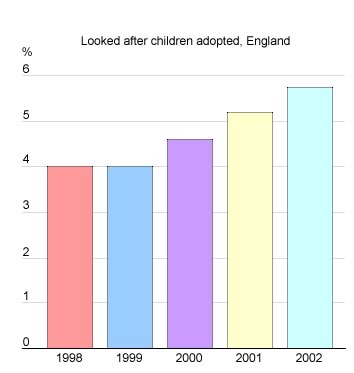
adopted increase. In 2000/2001 there were 3067 looked after children adopted in England, in 2001/2 this number increased to around 3,400 children. There
are estimated to be many more children who would benefit from being placed with new families, and where adoption is the plan for the child.
Most of these children are four years and older, and many are part of sibling groups. Nowadays,
adoption is used to provide permanent families for children of all ages, from infants to teenagers.  Detailed breakdown of adoptions in England 2001/2002 (DOH).
|
|
| |
|
Number of children adopted as a % of all children being looked after. Source DOH.
|
|

|
Age of children adopted as a % of all children being looked after who were adopted. Source DOH.
|
|
|
| |
As the above indicates only a very small number of the total children adopted each year are under the age of twelve months. If you wish to adopt a
baby you should expect to have a very long wait. Some agencies only consider adopters for very young children every few years and there may be more rigorous criteria
applied to these potential adopters. For example, many adoption agencies will be more likely to go for candidates who are free from any health problems,
have lived in the area for a long time and, if in a relationship, that it is a long standing one. Often adopters of these very young children are between
26 and 35 years of age. If you do not fit these requirements our advice is that you should consider adopting an older child.
The adoption agencies we work with may be a little more flexible for applicants from particular ethnic minorities who wish to adopt due to their
current difficulties in finding adopters who can meet the needs of some children.
Adopters of older children still have to meet certain criteria before they will be considered but many adoption agencies will feel it to be
worthwhile to look at each application on its own merits. For instance, if you have a medical condition this may be considered as outbalanced by your
experience of working with or bringing up children. One advantage of adopting an older child is that the period you might have to wait is reduced
significantly the older the child you are thinking about adopting.
There is a view that children over a certain age find it more difficult to accept their adoption or will not fit in with their adoptive family so easily.
In some cases this may be true but so much depends upon the child, the adoption agency workers, and the adoptive family that this is being disproved time
and time again. Children who are old enough to know about and who want to be adopted can be placed with families with great success so don't discount the
option of adopting an older child. They need a family just as much as an infant does.
|
|
|
Information Section. Page 4 of 34
|
|
|
|
|